with your family · 6 min read
how to help your child understand their emotions
name it, find it in the body, and let every feeling in

written by saddy babu · 20 october 2026
somatic practitioner and breathwork facilitator
the short answer
children feel emotions in their bodies long before they have words for them, so helping your child understand their emotions starts with lending them the words. name what you see (“you’re feeling cross because the tower fell”), help them find where they feel it, like a hot face or a tight tummy, and talk about a feeling as something they’re having rather than who they are. allow every feeling while you still limit behaviour, and name your own feelings out loud, because children learn by watching you.
in this article +
children feel first and find the words later
a feeling arrives in a child’s body well before it arrives in their vocabulary, as heat, tears or a howl from the floor. most children are using simple words like happy, sad, cross and scared by two or three, and the finer ones take years. until then, you’re their dictionary.
emotional literacy means noticing a feeling, naming it and understanding a little of what it’s about, and teaching children about feelings happens mostly in ordinary moments, at the bench, in the car and at bedtime.
why naming a feeling helps
psychiatrist dan siegel calls this “name it to tame it” in the whole-brain child, his book with tina payne bryson. in a 2007 brain-imaging study of thirty adults, picking a word like angry or scared for the emotion on a face lowered activity in the amygdala, a part of the brain involved in emotional reactions, more than just looking did. a 2026 review of 43 studies found the effect depends on the person and the situation, and people didn’t always say they felt better.
with children, the evidence comes from families. in the 1990s, psychologist john gottman and colleagues followed families from when the children were five until they were eight. parents who took feelings seriously, helped their child find words and worked through problems with them (he called it emotion coaching) tended to have children who managed their feelings better. that was early, observational work, but a 2023 review of fifteen randomised trials found that programs teaching these skills to parents gave young children’s emotional skills a moderate lift.
find the feeling in the body
children notice where a feeling lives in their body earlier than you might expect. in a finnish study, 331 children and teenagers aged six to seventeen coloured in body outlines to show where they feel different emotions. even the six-year-olds drew distinct maps for happiness, fear and surprise, and the maps grew more detailed and more like adults’ with age.
a hot face, a tight tummy, a lump in the throat and fizzy legs are all clues, and asking “where do you feel it?” can be easier than asking what they feel. noticing this inner sense, called interoception, is the same skill a body scan trains in adults, and it’s how a feeling gets caught while it’s still a whisper, before it becomes a scream.
a feeling is something your child has
here’s a small change in wording I care about a lot. “you’re feeling angry” describes something happening now, which will pass. “you’re an angry child” describes who they are, and a label repeated often enough can start to sound like a fact. the same goes for “such a worrier”, “the shy one” and “my sensitive one”.
so keep the words on the feeling: “there’s a lot of worry in you today”, or “you’re feeling shy with all these new people”. this way of speaking makes a feeling something that can move, like weather, with your child there noticing it.
every feeling is allowed, and some behaviour isn’t
you can welcome the feeling and still stop the hand: “you’re furious it’s not your turn. you’re allowed to be furious. I won’t let you hit.” gottman’s emotion coaching ends the same way, with limits set while you solve the problem together.
when a big feeling has revved up the whole body, try a short push and then a longer settle: press your hands hard against the wall together, then breathe out in three long snake hisses. in the thick of a meltdown, settle your own body first (that’s co-regulation), keep the words few and save the naming for afterwards (more in tantrums and meltdowns).
what to say at different ages
with toddlers, you do the naming, short and out loud, with the reason attached: “you’re sad. you wanted to stay at the park.”
with preschoolers, pictures help: “what’s the weather inside you? sunny, stormy, foggy?” or “what animal would that feeling be?” by four or five, many can tell you how they know they’re feeling something, so start asking where they feel it.
in the primary years, widen the vocabulary to frustrated, embarrassed, proud, jealous and left out. understanding that you can feel two things at once, like excited and nervous about camp, often comes late in primary school, so say it for them: “I think part of you is excited and part of you is nervous.”
with teenagers, skip the baby talk and offer your guess as something they can correct: “you seem flat since training. am I reading that right?” and let “I don’t know” be an allowed answer.
if your child’s feelings seem much bigger, longer-lasting or more frequent than you’d expect for their age, or they’re getting in the way of sleep, eating, school or friendships, talk to your gp.
your own feelings, out loud
children learn about feelings from the adults around them. in one small study that observed 41 children at home, three-year-olds who talked more about feelings with their family were better at recognising other people’s emotions at six.
so name your own, with what you’ll do about it: “I’m feeling frustrated, so I’m going to breathe out slowly before I answer.” that sentence gives a feeling a name and a plan, and of everything here, it’s the part I’d keep. when you ask how they’re feeling, go first, because children copy your honesty. name the good feelings too, the small moments of ease sometimes called glimmers, and when you get it wrong, which every parent does, a repair is part of the same lesson.
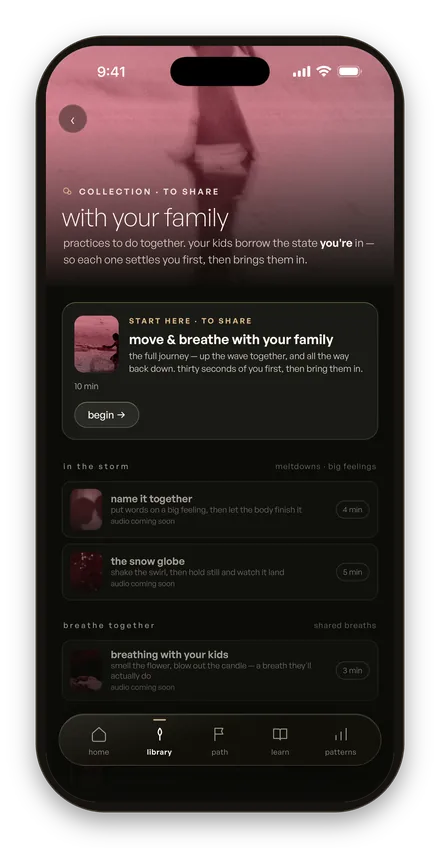
a practice for exactly this, name it together (put words on a big feeling, then let the body finish it), is on its way in the “with your family” collection in soma reset. and for your own body, my free guided body scan takes ten minutes.
common questions about your child’s emotions
what is emotional literacy?
+
emotional literacy is the ability to notice a feeling, name it and understand a little of what it’s about. children build it slowly in everyday moments: hearing their feelings named, finding where they feel them in the body, and watching how you handle yours.
what does ‘name it to tame it’ mean?
+
it’s psychiatrist dan siegel’s phrase for putting a feeling into words to help it settle. in a 2007 brain-imaging study, adults showed less amygdala activity when they named the emotion on a face than when they just looked. later research suggests it helps some people and moments more than others.
at what age do children start to understand their emotions?
+
it builds over years. most children use simple feeling words like happy, sad and cross by two or three, many four- and five-year-olds can say how they know they’re feeling something, and understanding two feelings at once often comes late in primary school.
what if my child won’t talk about their feelings?
+
don’t push. offer a light guess they can correct, ask where they feel it instead of what it is, try talking side by side in the car, and let “I don’t know” be an answer. if their feelings seem much bigger or longer-lasting than you’d expect for their age, talk to your gp.
keep reading
more from the practice
6 min readnewco-regulation with your childhow your calm becomes theirs, from babies to big kids6 min readnewtantrums and meltdowns, through the nervous systemwhat helps in the moment, what helps after, and why lectures don’t land6 min readnewwhat are glimmers?the small moments of ease your body notices first




written by saddy babu
everything I share is anchored in somatic and nervous-system work, but expressed through the language of presence, intuition, and emotion.
- certified somatic practitioner & nervous system educator
- certified breathwork facilitator
- specialising in parts work & emotional integration
your body learnt the pattern.
it can learn a new one.
start your path. ten minutes, in your own time.
begin →7 days free · then $19.97/mo · cancel anytime
— saddy