with your family · 6 min read
co-regulation with your child
how your calm becomes theirs, from babies to big kids

written by saddy babu · 20 october 2026
somatic practitioner and breathwork facilitator
the short answer
co-regulation is one nervous system settling with the help of another. children can’t settle big feelings on their own at first, so they borrow steadiness from the adults close by: your voice, your face, your pace, your arms. self-regulation grows out of thousands of these borrowed moments, from rocking a baby to sitting beside a nine-year-old after a rough afternoon. that’s why your own state comes first, and why coming back after you lose it is part of the same skill.
in this article +
what is co-regulation?
co-regulation starts at birth, and it’s well supported by child development research. the harvard center on the developing child calls the everyday version serve and return: a baby babbles, gestures or cries, an adult answers with eye contact, words or a hug, and those exchanges help build the brain connections behind communication and social skills. in the still-face studies psychologist ed tronick began in the 1970s, a parent playing face to face with their baby goes blank and unresponsive for a short stretch. babies only a few months old keep trying to restart the game, then turn away and get upset, and when the parent comes back they brighten again, though some of the upset lingers.
co-regulation is often explained through polyvagal theory, a model many researchers dispute, but the developmental research doesn’t depend on it. it has its own limits: much of it has studied mothers and babies, leaving less to go on for fathers and other carers, and co-regulation programs change what parents do more reliably than they change babies’ and toddlers’ own regulation, at least so far.
co-regulation vs self-regulation
self-regulation is settling yourself: managing your feelings and actions well enough to do what you mean to. a 2017 government-funded brief by katie rosanbalm and desiree murray at duke university defines it as “the act of managing thoughts and feelings to enable goal-directed actions”, which is the same idea in a lab coat (my nervous system glossary skips the lab coat). self-regulation grows out of co-regulation, a little at a time: first you settle them, then you settle with them, then you stay within reach while they try it on their own.
your state comes first
the duke brief says it plainly: a caregiver’s capacity for co-regulation depends in large part on their own self-regulation, and an adult who is feeling overwhelmed may even add to a child’s agitation.
sara waters and colleagues had mothers give a speech, alone or to evaluators, some of whom frowned and shook their heads, then reunited them with their babies, aged 12 to 14 months. babies whose mothers had faced an audience showed heart rate rises mirroring their mothers’ reactions, and were warier of a stranger. the authors note that moving together isn’t proof of cause, and touch may have played a part, since the babies sat on their laps.
co-regulation asks for a steadier adult, which is a lower bar than a calm one. your heart can be going and your voice firm while you still feel your feet on the floor: in my language that’s mobilised, with self (“I can still feel myself”), and it’s enough for a child to settle against. past the edge of your window of tolerance, where you’re mobilised, with fear, there’s far less steadiness to borrow, and my article on nervous system regulation for parents has 90-second practices for coming back.
co-regulation with babies
with a baby, you do almost all the regulating: the duke brief notes that infants have little capacity to change their own experience, so the adult manages the feed, the temperature, the noise, and the comfort when it all gets too much. co-regulation here looks like rocking, a low, slow voice, a walk up the hallway with them against your chest. if the crying goes on and nothing seems to touch it, when your baby won’t stop crying goes further.
co-regulation with toddlers
toddlers are where co-regulation gets loud. the duke brief describes toddlers as having strong emotions that far outweigh their emerging skills, which anyone who has watched a banana break the wrong way will recognise. get low, near their eye level. use fewer words, since a toddler deep in a big feeling can’t take in much language. keep your own body steady, with a long breath out and heavy shoulders, and let the feeling run its course beside you. the brief lists turning to adults for help with strong feelings as a toddler self-regulation skill, so a toddler who collapses into you mid-meltdown is doing it right. toddler tantrums and meltdowns covers the storm itself.
co-regulation with school-age children
by school age, co-regulation moves from your arms into your company. naming helps: a plain guess at the feeling, like “that sounded really disappointing”, gives a child words for what’s happening inside, which is how they come to understand their emotions. a walk together helps, side by side, where nobody has to hold eye contact. and a breath helps when it’s one they’ll actually do, which usually means a picture: smell the flower, then blow out the candle, slowly. do it with them, because they’re copying your body as much as your words.
it keeps going: the duke team’s companion brief follows co-regulation from birth through young adulthood. by the teenage years, it’s often a steady voice on the phone.
at any age, if your child’s distress seems beyond the ordinary, or you’re simply worried, talk to your gp or child health nurse.
repair after you lose it
you will lose it sometimes, and co-regulation has room for that. when ed tronick and jeffrey cohn filmed mothers and babies playing face to face, the pairs spent only a small share of the time in step; most of the interaction was moving out of step and back again. getting back in step is ordinary, and children learn it by watching you.
repair doesn’t need a script. settle your own body first, even by one breath. say what happened in a sentence or two, and own your part without asking your child to look after your feelings about it. then reconnect through the body: sit close, offer a hug, or breathe out slowly together.
practising together
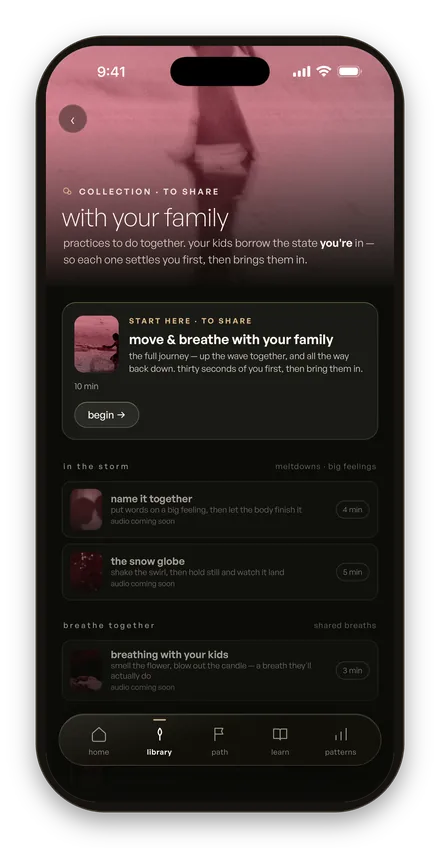
co-regulation is also worth practising on an ordinary day, when nobody is upset, so it’s familiar by the time somebody is. inside soma reset there’s a “with your family” collection of practices to do with your kids, and move and breathe with your family takes everyone “up the wave together, and all the way back down”. there are practices for you too, and my free guided body scan takes ten minutes, no sign-up needed.
common questions about co-regulation
what is co-regulation in simple terms?
+
co-regulation is one nervous system settling with the help of another: a child borrows steadiness from a nearby adult’s voice, face, touch and pace until their own body settles. adults keep using it all their lives.
what’s the difference between co-regulation and self-regulation?
+
self-regulation is settling yourself, managing your feelings and actions well enough to do what you mean to. co-regulation is settling with help from someone steadier, and self-regulation grows out of thousands of co-regulated moments.
what are some examples of co-regulation?
+
rocking a crying baby while you hum, getting down low beside a toddler mid-meltdown and saying very little, walking around the block with a ten-year-old after a hard day, or blowing out a pretend candle together, slowly. each time, your steadier body does some of the settling.
how do I co-regulate with a toddler?
+
get down to their level, use fewer words, and keep your own body steady, with a long breath out and heavy shoulders. stay close while the feeling runs its course, and save the explaining for afterwards. if you’re near your limit, take one slow breath first.
keep reading
more from the practice
5 min readregulation for parentswith the kids in the room — co-regulation, 90-second reps, repair over perfection6 min readnewhow to help your child understand their emotionsname it, find it in the body, and let every feeling in6 min readnewtantrums and meltdowns, through the nervous systemwhat helps in the moment, what helps after, and why lectures don’t land




written by saddy babu
everything I share is anchored in somatic and nervous-system work, but expressed through the language of presence, intuition, and emotion.
- certified somatic practitioner & nervous system educator
- certified breathwork facilitator
- specialising in parts work & emotional integration
your body learnt the pattern.
it can learn a new one.
start your path. ten minutes, in your own time.
begin →7 days free · then $19.97/mo · cancel anytime
— saddy